



Prostate Enlargement Surgery Using the Latest Medical Techniques
The Role of Laser in Modern Prostate Surgery
Benign Prostatic Hyperplasia (BPH) Treatment
Restore comfort and health under the care of Dr. Yaman Altal
Many men suffer from prostate issues such as benign prostatic hyperplasia (BPH) or other prostate-related conditions. These may include difficulty urinating, frequent nighttime urination, weak urine flow, or reduced quality of daily life.
Under the care of Dr. Yaman Altal — Consultant Urologist and Men’s Health Specialist — we offer comprehensive and modern solutions using the latest technologies for accurate diagnosis and effective prostate treatment.
What Is the Prostate and What Problems Affect It?
The prostate is a small gland located below the bladder, forming part of the male reproductive system. When it becomes enlarged or inflamed, it may press on the urethra, causing urinary problems.

Dr. Yaman Altal
Consultant in Andrology, Sexual Medicine & Penile Implant Surgery
- 14 years of experience in the United Kingdom.
Subspecialty training at Imperial College London in prostate, robotic, and endoscopic surgeries
Common symptoms include:
Weak urine stream
Frequent urination and difficulty urinating
Post-urination dribbling
Urgency (sudden need to urinate)
Urinary incontinence (urine leakage)
Frequent nighttime urination
How is Benign Prostate Enlargement Diagnosed?
If you experience any of the symptoms above, visit a specialist in urology and prostate surgery.
The doctor examines the prostate through the rectum and performs:
PSA blood test
Urine analysis
Urine flow test
These symptoms may sometimes result from non-benign prostate conditions, so anyone experiencing them should see a urologist for reassurance.
In some cases, the patient may also need:
Ultrasound imaging
Bladder studies
Treatment of the Prostate and Prostate Enlargement
When considering prostate surgery, it is important to know that mild cases of prostate enlargement do not require treatment, and the patient may simply live with the condition.
Moderate cases are treated medically with:
Alpha-blockers
5-alpha reductase inhibitors
These medications may cause retrograde ejaculation, which is not concerning and is not a reason to stop treatment unless the patient is planning to have children.
Some natural remedies may help improve symptoms — such as pumpkin seed oil — but they do not have strong scientific evidence and do not replace consulting a urology specialist.
Surgical Treatment of Prostate Enlargement & Prostate Removal by Laser
Surgery is recommended in the following cases:
Recurrent infections
Urine backflow (reflux)
Repeated urinary retention
Acute urinary retention
Patient preference
Surgical Options for Prostate Enlargement
Bladder Neck Incision
A simple procedure performed for some patients at a younger age.
TURP (Transurethral Resection of the Prostate)
The traditional procedure with long-term, well-known results.
It is simple and safe, and is considered the best method if the prostate is less than 100 grams.
Laser Prostatectomy
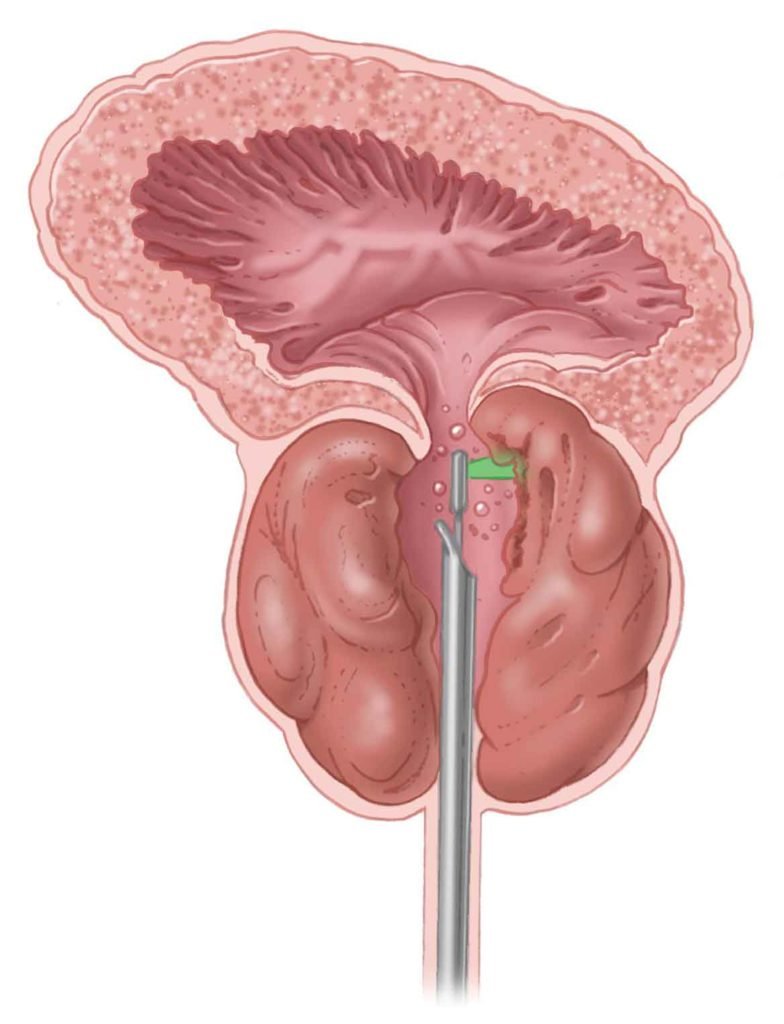
Laser removal of the prostate is a modern procedure for treating benign prostate enlargement.
It removes excess tissue precisely using laser technology to improve urine flow and reduce bothersome symptoms, with Faster recovery, less bleeding and less pain than traditional surgery.
Types of Laser Prostate Surgery
Holmium Laser Enucleation of the Prostate (HoLEP)
This is the best type of laser surgery and is recommended especially when the prostate size exceeds 100 grams.
Dr. Yaman Altal is one of the experts in all types of laser prostate surgery.
Urolift Procedure
A relatively new treatment with minimal complications for specific cases.
It is currently not available in Jordan, but Dr. Yaman performs it in London.
GreenLight Laser Vaporization
Laser vaporization of the prostate — the GreenLight laser is preferred because it achieves the best results.
The advantage of laser treatment is reduced bleeding, making the operation suitable for many patients.
Book Your Consultation Now
To contact Dr. Yaman Altal directly via WhatsApp:

FAQs
Is prostate disease dangerous?
Benign prostate enlargement (BPH) is not dangerous in most cases and is different from prostate cancer. It is important to see a urology specialist for examination and confirmation.
What is the cost of prostate surgery?
The cost of prostate surgery in Jordan ranges between 2,200 and 3,500 Jordanian Dinars, and this price depends on several factors such as the size of the prostate and the type of technique used.
Dr. Yaman Altal, Consultant Urologist and Prostate Specialist in Jordan, provides all available and best surgical options for treating prostate conditions.
Prostate surgery is very safe when performed by an experienced and skilled urologist. Patients should carefully choose their surgeon and should not avoid the operation out of fear of symptoms, as delaying treatment may cause unnecessary suffering.
Is the surgery painful?
The procedure is performed under spinal or general anesthesia, and the patient does not feel any pain during the operation. The recovery period is also shorter compared to traditional surgery.
How long is the hospital stay after the operation?
In most cases, the patient can leave the hospital within just 24 hours and gradually return to normal activity within a few days.
Does the surgery affect sexual ability or ejaculation?
Laser prostate surgery usually does not affect sexual desire or erection. However, a slight change in ejaculation may occur, called “retrograde ejaculation,” which is safe and does not affect sexual pleasure.
What are the advantages of laser prostatectomy compared to traditional surgery?
Laser prostate surgery is characterized by less bleeding, faster recovery, and no surgical incision. It also reduces the need for prolonged catheter use and allows the patient to return to normal life quickly.
Can prostate enlargement recur after the operation?
In most cases, the results are long-lasting, and prostate enlargement rarely returns after laser surgery, especially when patients follow up regularly and adhere to the doctor’s instructions.
How do I prepare for the operation?
Before the operation, it is recommended to perform blood and urine tests, evaluate the size of the prostate, and stop certain blood-thinning medications if present. The doctor explains all the steps to the patient to ensure a safe procedure and excellent results.